
Morning Routines That Actually Stick
Learn how to build a morning routine you won’t abandon by week two. Includes the psychology behind why most routines fail and what actually works.
A simple system for organizing your day that doesn’t require apps or complex templates. Takes five minutes to set up.

Planning your day shouldn’t feel like a project. Yet most people either skip it entirely or spend 20 minutes fiddling with apps, color-coding systems, and templates that nobody actually maintains past Wednesday.
The one-page method solves this. It’s not fancy. It doesn’t sync across devices or send you notifications. What it does is work — because it’s designed around how your brain actually operates, not how productivity companies think it should.
Setup time
That’s all you need
Just paper or notes
Here’s what makes this different from bullet journaling or task managers. You’re not creating a system — you’re creating a snapshot. One sheet of paper. One time per day. That’s it.
When you sit down in the morning (or the night before, depending on what works for you), you write three things:
That’s the structure. No sections for “someday” or “next month.” No color coding. Just what’s actually happening today.


Most planning systems fail because they ask too much. You’re supposed to categorize, prioritize, reflect, track progress, and review weekly. By day four you’re tired of it.
This method survives because it’s ridiculously simple. There’s nothing to maintain. You write it once, you’re done. Tomorrow you start fresh. No guilt about incomplete sections or outdated goals staring at you from last month.
It also works because it’s honest. Your three priorities aren’t some aspirational vision — they’re what you’re actually going to focus on. Your regular tasks are real. Your brain knows you’re not lying to yourself, which is why you actually follow through.
Plus, there’s something tactile about it. Writing with your hand engages your brain differently than typing. You remember what you wrote. You’re more likely to actually do it.
You need: paper or a notes app, a pen, and five minutes. That’s the entire setup.
The paper version works better if you have it. Something about seeing it physically in front of you — on your desk, on your nightstand — keeps it in your awareness. A notebook that costs three dollars. A page per day. You can finish a notebook in about four months.
Write the date at the top. Draw a line halfway down the page. Top half is priorities and regular tasks. Bottom half is your wildcard. Some people add a small notes section on the side for thoughts that pop up during the day. Some keep it completely clean. There’s no wrong format.
The real trick isn’t the layout — it’s being honest about your three priorities. Not what you wish you’d do. What you’re actually going to prioritize today. If you’re drowning in work, maybe your three priorities are all work-related. If it’s a recovery day, maybe they’re rest, movement, and one small thing. It changes every single day, and that’s fine.
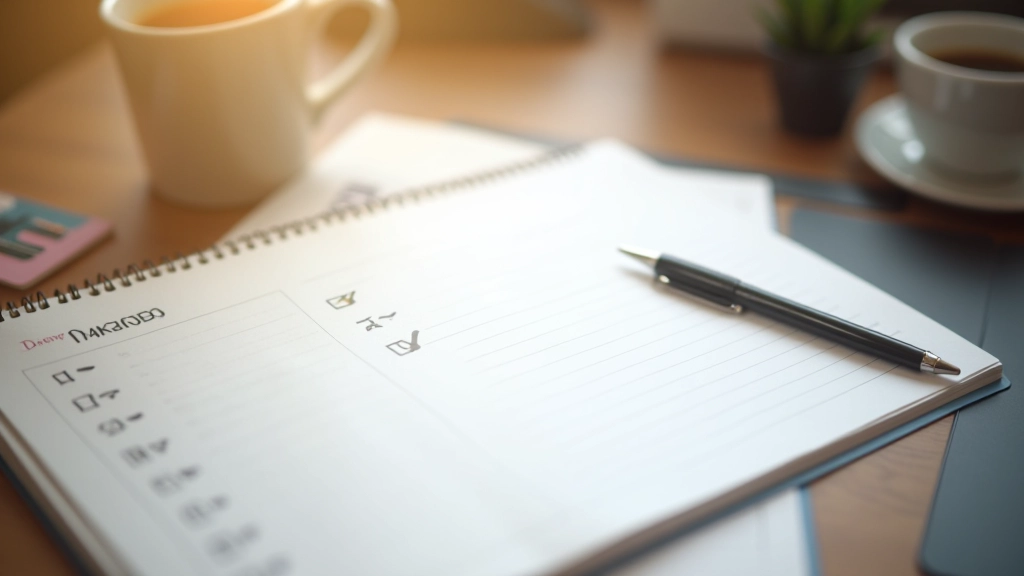
You won’t complete everything. Some days you’ll get one priority done and that’s it. That’s not failure — that’s reality. And this system handles it better than most because there’s no guilt attached.
You look at your page at the end of the day. You see what actually happened. If something didn’t get done, it either moves to tomorrow (gets written on tomorrow’s page) or it wasn’t actually important. You figure that out quickly.
Some people find that their three priorities are too ambitious. They’re only hitting one or two. That’s useful information. Next week they’ll set smaller priorities. Others realize they’re underutilizing their time — they’re crushing all three priorities by noon. They add more regular tasks or get ambitious with the wildcard. The system teaches you about yourself.
And if you skip a day? You don’t need to catch up. You just write tomorrow’s page. There’s no backlog of incomplete planning, no feeling like you’re behind. You start fresh every single morning.
This isn’t a productivity hack that’ll make you superhuman. It’s not going to turn you into a person who gets 47 things done before breakfast. It’s a system for being honest about what you’re capable of in a day and following through on the things that matter.
Results vary depending on your work, your life situation, and how consistently you use it. For some people it transforms their relationship with planning. For others it’s just a useful tool that makes mornings slightly clearer. Both outcomes are totally fine.
You don’t need an elaborate system. You need clarity about what matters today. You need to write it down. You need to follow through. Everything else is noise.
A single sheet of paper does that. It’s simple enough that you’ll actually use it. It’s flexible enough that it works on crazy days and calm days. And it’s honest enough that you won’t pretend you’re more capable than you actually are.
Try it for a week. One page per day. Three priorities, regular tasks, one wildcard. See what you learn about yourself. Most people who stick with it realize it wasn’t the system that changed — it was the clarity. And clarity, it turns out, is worth more than any app.